

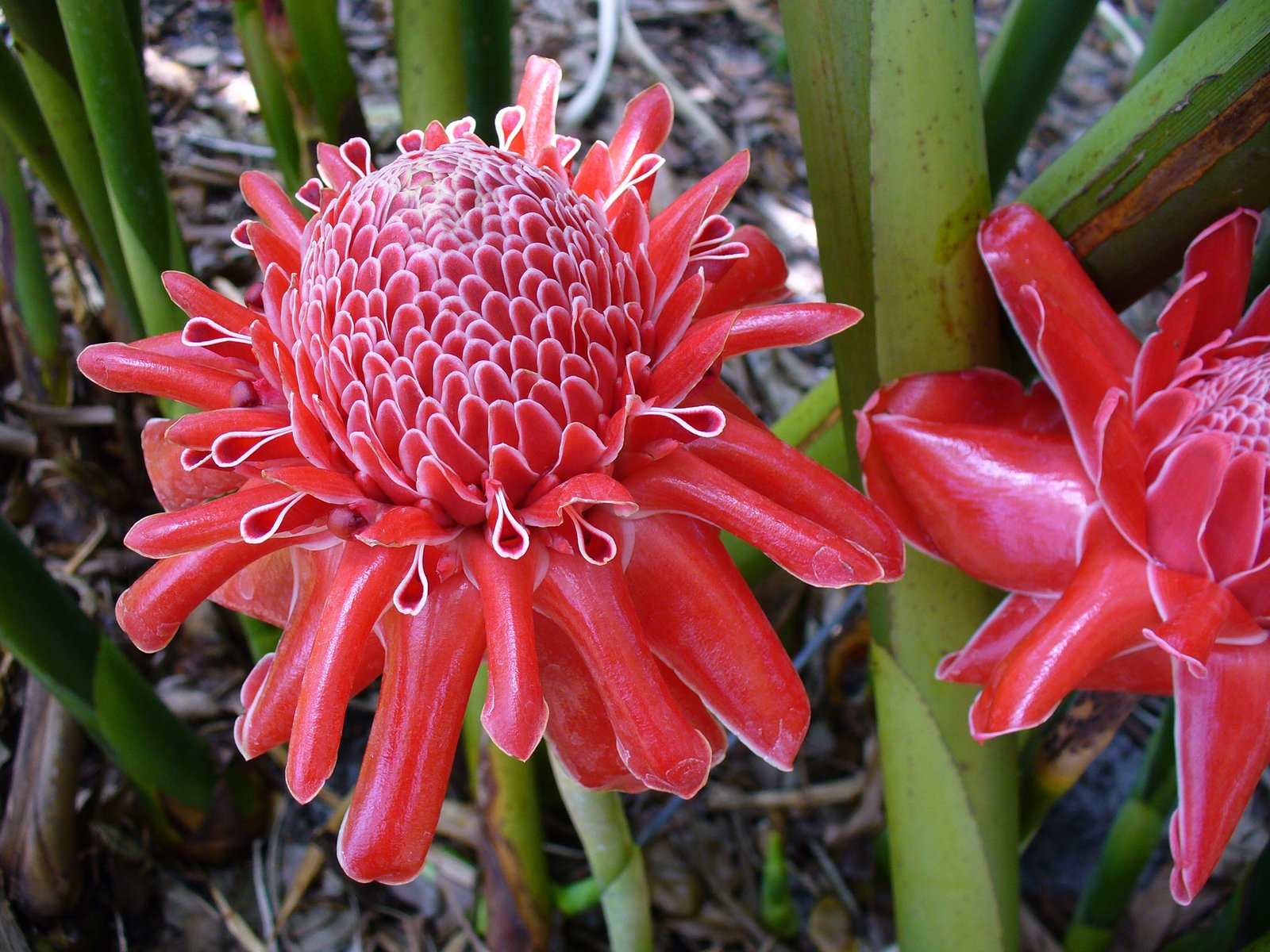
Picture a towering, flaming-red flower. It looks less like a plant and more like a wax sceptre. If you happened to encounter one in a 19th-century European capital, it was likely sitting behind the thick, humid glass of a royal botanical garden. Beside it, a neat brass plaque would bear its freshly assigned Latin name: Etlingera elatior.
To the European botanists who carefully crated and shipped these rhizomes from Southeast Asia, the torch ginger was merely an ornamental novelty. A pretty thing to look at; a trophy of empire to be sketched in leather-bound journals. They meticulously cataloged its waxy petals, marveled at its fifteen-foot stalks, and completely missed the point.
While the botanists were busy debating how best to arrange it in a conservatory vase, Southeast Asian communities had long since figured out that this plant belonged in a mortar and pestle.
It’s the classic colonial mindset: mistaking a functional plant for a simple decoration just because it happens to be beautiful (the same can’t be said for breadfruit, however). The communities living in the dense, humid forests of Malaysia, Indonesia, and southern Thailand possessed the ecological wisdom to recognize that the true value of the plant wasn’t in the blooming flower, but in the tight, unopened bud.
We aren’t here to admire the foliage. We are going to look past the glass of the botanical garden and explore how indigenous science turned a rainforest giant into a champion of Southeast Asian flavour bases.
A Flavor Bomb
If you’ve never tasted torch ginger, throw out your frame of reference for edible flowers. This isn’t a delicate pansy resting sadly on top of a Michelin-starred salad. It is an aggressive, beautiful collision of tartness, floral aromatics, and heat.
Imagine the zesty, acidic bite of pink grapefruit crashing into the sharp warmth of young ginger, finishing with a lingering, soapy-in-the-best-possible-way floral note.
Sliced raw, it offers a satisfying, fibrous crunch that demands your attention. Simmered in a broth, it yields its volatile oils to make any pot of liquid fragrant and citrusy.
Torch ginger provides that deep, layered complexity that plant-based cooking constantly chases. It can hold its own against the heavy coconut milks and fiery chilies of the region, without the need for lab-synthesized flavorings.
Jungle Intelligence
There is a persistent, lazy narrative in food history that treats indigenous culinary practices as happy accidents. The assumption is that communities in the tropics only ate things like torch ginger because they were starving and desperate. They must have just boiled everything until something tasted good, the logic goes.
Utter rubbish.
For groups like the Batak of North Sumatra or the Orang Asli of Malaysia, the dense rainforest wasn’t a terrifying unknown. It was an open-source pantry and rigorous laboratory. Nobody stumbled upon the culinary potential of torch ginger by tripping over it. It was the result of deliberate, generational research and development.
These communities understood the broader ginger family (Zingiberaceae) deeply. They knew these plants held intense culinary and medicinal value. They tested, they tasted, and they refined. More importantly, they mapped out the plant’s life cycle and identified the exact, fleeting window of time when the bud was packed with the perfect concentration of oils and acids.
Timing is Everything
Nothing about torch ginger is subtle. It grows from massive underground rhizomes, shooting up thick stalks that can easily clear fifteen feet. It’s a plant that demands the oppressive humidity and rich soil of the tropics.
But the genius of its culinary application lies entirely in the harvest. If you wait for the flower to bloom, you’ve waited too long. Once the petals open, the essential oils dissipate and the flesh turns aggressively woody.
The culinary magic is locked exclusively inside the tight, unopened bud—known as bunga kantan in Malaysia and kecombrang or honje in Indonesia.
Getting to that bud is hard labour. It requires wading into dense, towering clumps of vegetation and expertly slicing the stalks at the base. You have to catch the plant in a fleeting, liminal state: just as the bud swells with aromatic power, but right before the petals break. It requires a farmer who knows the rhythm of the rainforest, not just a pair of secateurs.
Slicing, Pounding, and Simmering
Once you have the bud in your kitchen, you can’t just hack at it like an onion. Torch ginger commands respect on the cutting board.
If you intend to eat it raw, you are walking a fine line. The outer layers hide a fibrous armor that must be broken down. It requires a sharp knife and impossibly thin slicing, shaving the bud down into ribbons that look like bright pink confetti. Cut it too thick, and your guests will be chewing on aromatic mulch. Cut it perfectly, and it melts across the palate, releasing its sharp, floral heat.
If you are building a broth or a curry, the approach changes. The bud is often halved or bruised with a heavy stone pestle. You aren’t trying to pulverize it, you are fracturing the cell walls. This controlled trauma releases the bud’s volatile essential oils so that when it hits the pot, it instantly transforms the liquid.
The Torch in the Kitchen
But to truly understand torch ginger, you have to see it in action. Across Southeast Asia, it doesn’t just flavour dishes. It acts as the anchor for some of the most dynamic regional recipes in the world.
Malaysia’s Asam Laksa
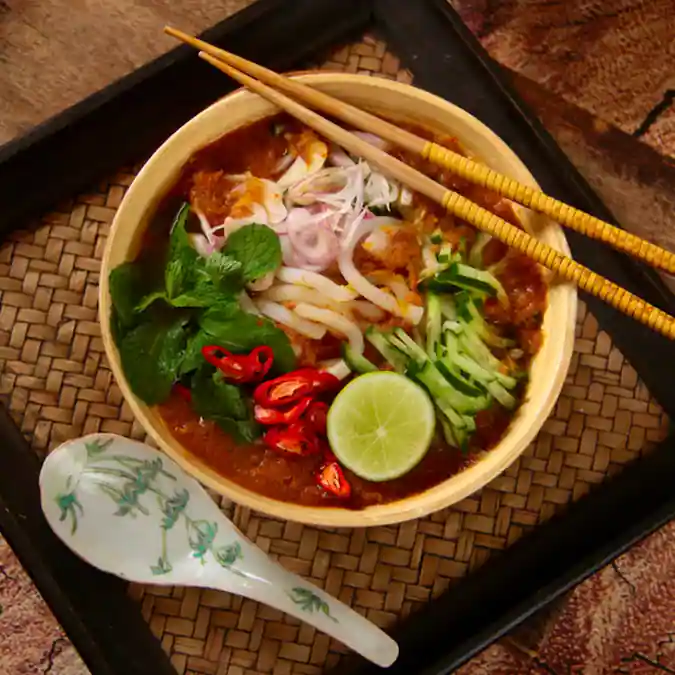
If you travel to Penang and order a bowl of asam laksa, you are preparing yourself for a sensory assault. This isn’t a gentle, comforting noodle soup. It is a sour, fiery, deeply umami broth that commands your full attention. And at the absolute center of that broth is bunga kantan.
The torch ginger isn’t just a garnish. The broth relies heavily on tamarind for its signature sourness, but tamarind alone is heavy and one-dimensional. The bruised halves of torch ginger cut straight through that heaviness, injecting an acidity that elevates the entire bowl. Remove the bunga kantan, and the laksa becomes nearly unrecognizable.
Indonesia’s Raw Power
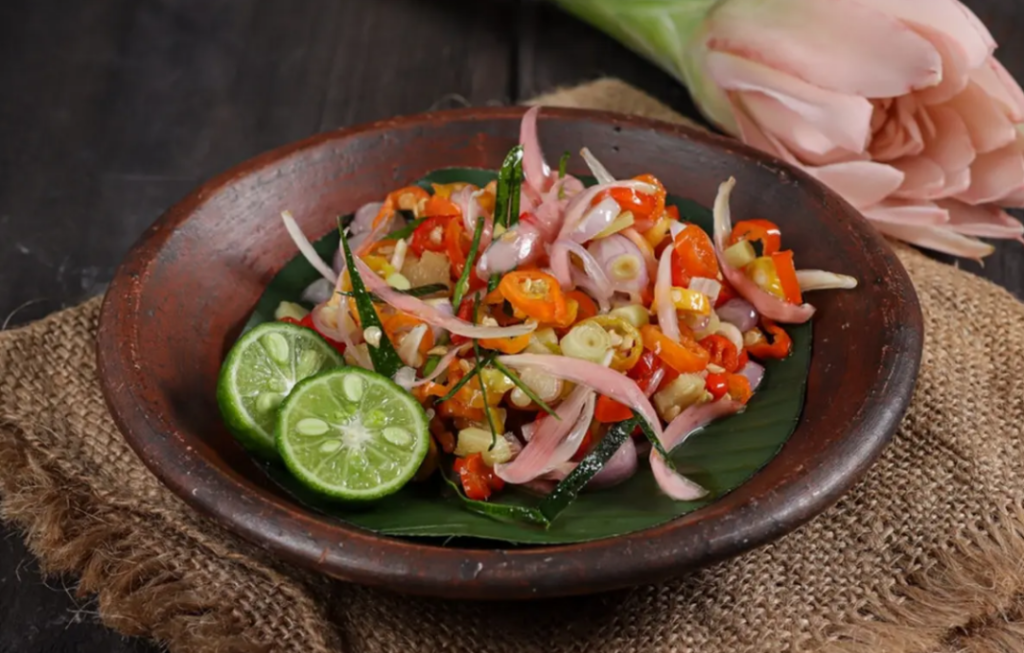
Head south to the Indonesian archipelago, and the application of torch ginger splits into two distinct directions: the raw and the slow-cooked.
In Bali, kecombrang is the undisputed star of sambal matah. This is a raw, un-pounded sambal made of finely shaved shallots, bird’s eye chilies, lemongrass, and torch ginger, all dressed in coconut oil and a squeeze of lime. The torch ginger acts as a palate cleanser, resetting your tastebuds between bites of rich food. It is a slap in the face in the best way possible.
In North Sumatra, the Batak people use the bud (and often the tough, lower stalks) to build arsik. While traditionally a fish dish, the magic lies in the bumbu—the deeply complex spice paste that forms the base of the stew. Simmered for hours with andaliman pepper (a citrusy relative of Sichuan peppercorns), the torch ginger breaks down completely, infusing the sauce with an earthy heat. While food scientists burn millions trying to engineer complex plant-based flavor profiles in sterile labs, the Batak people perfected the blueprint centuries ago. The bumbu is inherently vegan, and it builds a depth that faux-meats can only dream of.
Southern Thailand’s Khao Yam
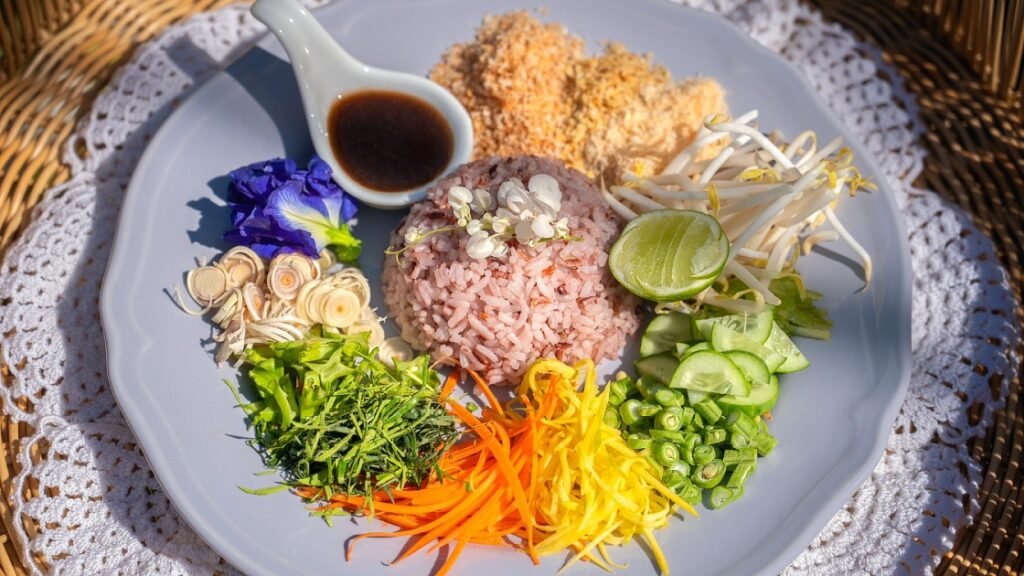
In the southern provinces of Thailand, torch ginger crosses the border under the name daalaa. Here, it is most famously deployed in khao yam, a visually stunning rice salad.
Khao yam is a masterclass in balance. Earthy rice is tossed with toasted coconut, sour mango, and a mountain of finely sliced herbs. The daalaa is shaved raw over the top, acting as a pink garnish that performs the heavy lifting of tying the disparate ingredients together. It proves that torch ginger is just as comfortable playing the role of a sharp accent as it is anchoring a slow-simmered curry.
Igniting the Modern Pantry
Honoring indigenous research and development doesn’t mean we have to freeze these ingredients in time. Torch ginger is a living, breathing culinary tool, completely ready to transform your plant-based cooking. You just have to know how to deploy it.
The Ultimate Vegan Ceviche
Most plant-based ceviches rely on young coconut meat or hearts of palm, leaning entirely on heavy pours of lime juice to mimic the curing process of seafood. It works, but it can be flat. Try swapping half your citrus for a generous shower of finely shaved torch ginger. It delivers a sharp, floral acidity and a crunchy aromatic bite that lime juice alone simply cannot achieve.
Compound Plant-Butters
Take a high-quality cultured cashew or almond butter. Fold in a handful of minced torch ginger and a heavy pinch of flaky sea salt. You have just created a tropical compound butter that will instantly elevate anything it touches. Melt it over blistered corn, toss it with roasted root vegetables, or let it ooze over a thick cut of grilled cabbage.
The Infusion
If you want to bottle the magic, aggressively bruise a few torch ginger buds and submerge them in a neutral oil or a mild rice vinegar. Let it macerate in a dark cupboard for a few weeks. The resulting infusion is an impressive condiment, ready to be whisked into dressings or drizzled over silken tofu, beating anything you can buy in a supermarket aisle.
The Future of the Flame
Think back to that 19th-century European botanist, standing in a humid conservatory, sketching the waxy red petals of the Etlingera elatior. They missed out on centuries of flavour because they couldn’t imagine that the people of the rainforest had anything to teach them about science, agriculture, or taste.
Today, we know better. True flavor innovation doesn’t come from a sterile laboratory or a marketing boardroom. It comes from the generations of indigenous communities who knew how to read a forest, who understood that the greatest ingredients on earth require patience, precision, and respect.
Torch ginger is no longer trapped behind the glass of the botanical garden. The next time you find yourself in a local Asian grocer, skip the produce aisles you recognise and head for the fresh herbs or check the freezer section.
Take one home. Smell it. Slice it thin or smash it with a pestle. When you finally taste that beautiful collision of citrus and fire, remember that you aren’t just eating a flower. You are tasting a piece of indigenous brilliance that refused to be reduced to an ornament.