

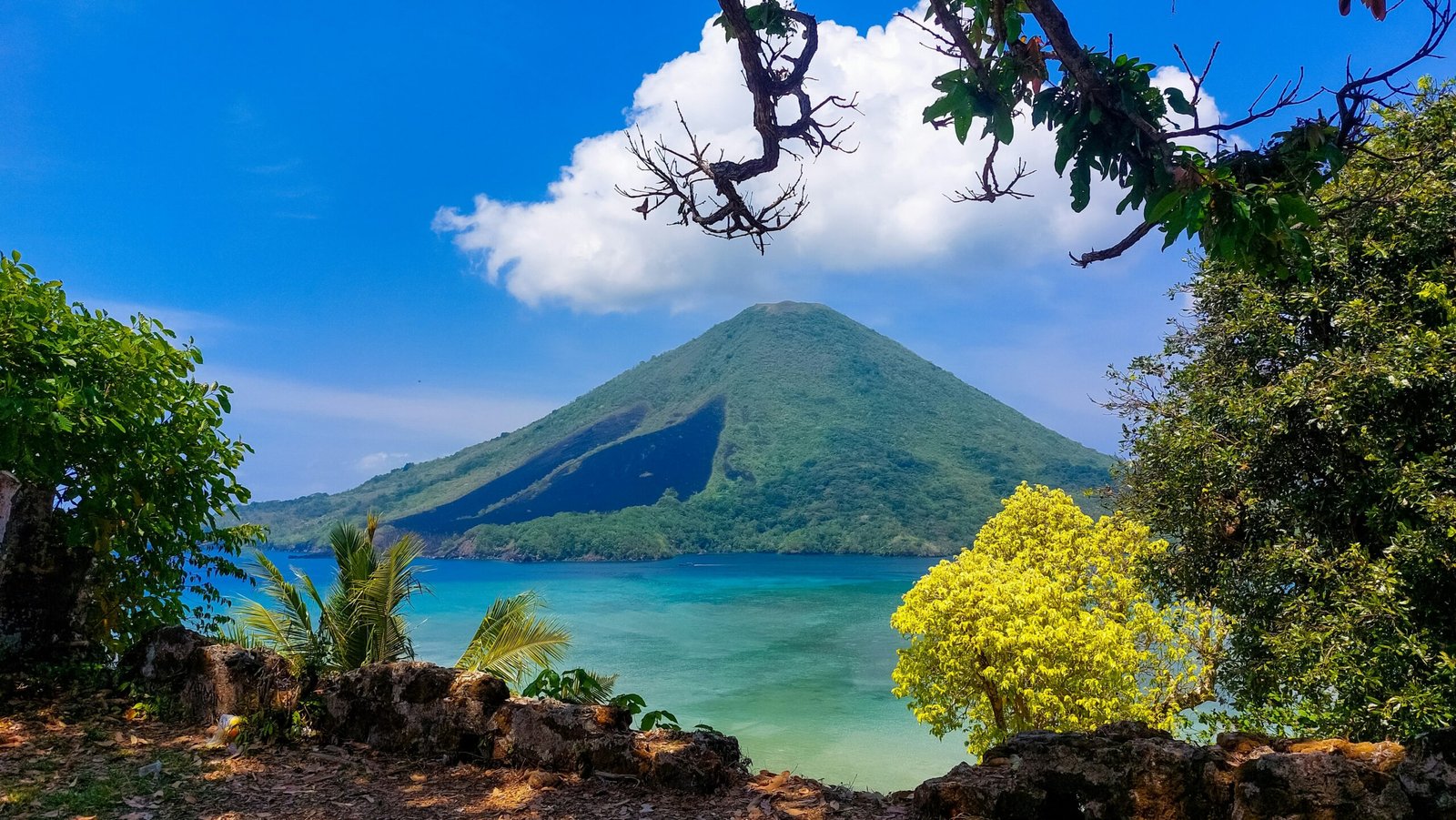
If you arrive by sea, you can smell the Maluku Islands long before your boat docks.
At the ferry port of Ternate, the humid air hits you with the sharp, almost medicinal scent of drying cloves. They are laid out everywhere to bake under the equatorial sun: on woven mats in front yards, on the shoulders of steep mountain roads, and, if you arrive by air, right there on the asphalt of the runway itself.
If you flip open a standard Western history book, the narrative you’ll find treats this scent as a beacon at the edge of the world. To the European empires of the 16th and 17th centuries, this archipelago of over a thousand islands—which they so unimaginatively branded the “Spice Islands”—was a distant, mythical prize to be discovered, conquered, and squeezed for profit.
But pull back and look at a map of pre-colonial trade routes, and a very different reality emerges. With their deep-water ports and predictable monsoon winds, these islands were never the end of the earth. For thousands of years, for Austronesian navigators, Chinese merchants, and Arab traders, the Maluku Islands were the undeniable center of the global economy.
It’s time we stop treating these islands as a mere backdrop for European galleons and start giving credit where it’s due. The Maluku Islands are an enduring botanical powerhouse, forged by extreme geography and millennia of indigenous expertise. We aren’t here to rehash a colonial conquest. We are here to understand how a profoundly intelligent culture, living in the shadow of smoking calderas, quite literally flavored the modern world.
A Tale of Two Spices
Before we get into that, let’s start with some botanical trivia: is a clove a seed like so many other spices?
You may be surprised to know that it is in fact a thwarted flower.
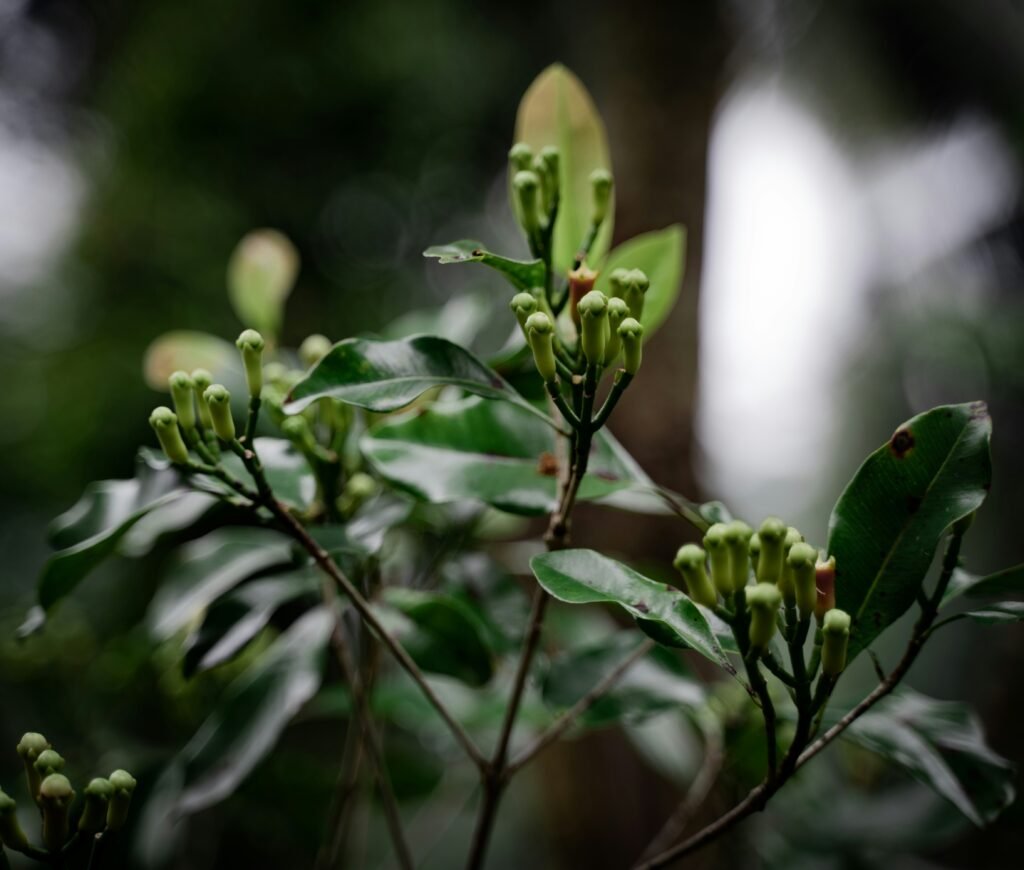
The syzygium aromaticum is a towering evergreen that thrives on the steep slopes of Ternate and Tidore—perfect, imposing cones of basalt and ash rising straight out of the ocean. Here, the nutrient-dense volcanic soil provides the perfect drainage for the trees. The buds start out pale, turn green, and then flush a brilliant crimson right before they open. That exact crimson moment is the window. The harvest demands human eyes and human hands. It is precarious, dizzying work; farmers must scale the tall, swaying branches on bamboo ladders to meticulously hand-pluck only the ready clusters.
You might wonder why, in an era of mechanized agriculture, this process hasn’t been automated. The answer is simple: the trees refuse to cooperate with industrial timelines. The buds on a single branch ripen at entirely different rates. A machine shaking the canopy would blindly strip the tree, yielding a useless mix of overripe flowers, bitter green buds, and the perfect crimson ones, all while destroying the branches for future harvests.
Once back on the ground, the freshly picked clusters are separated from their stems by hand. (The stems are pressed for clove oil, but the premium spice is the bud alone). Then comes the bake. Spread across mats in the direct sunlight, the buds dry for three to seven days. They require constant raking to prevent mould. You know the transformation is complete when they have lost two-thirds of their weight and snapped from that brilliant crimson into the hard, woody-brown colour we recognize in a spice jar.
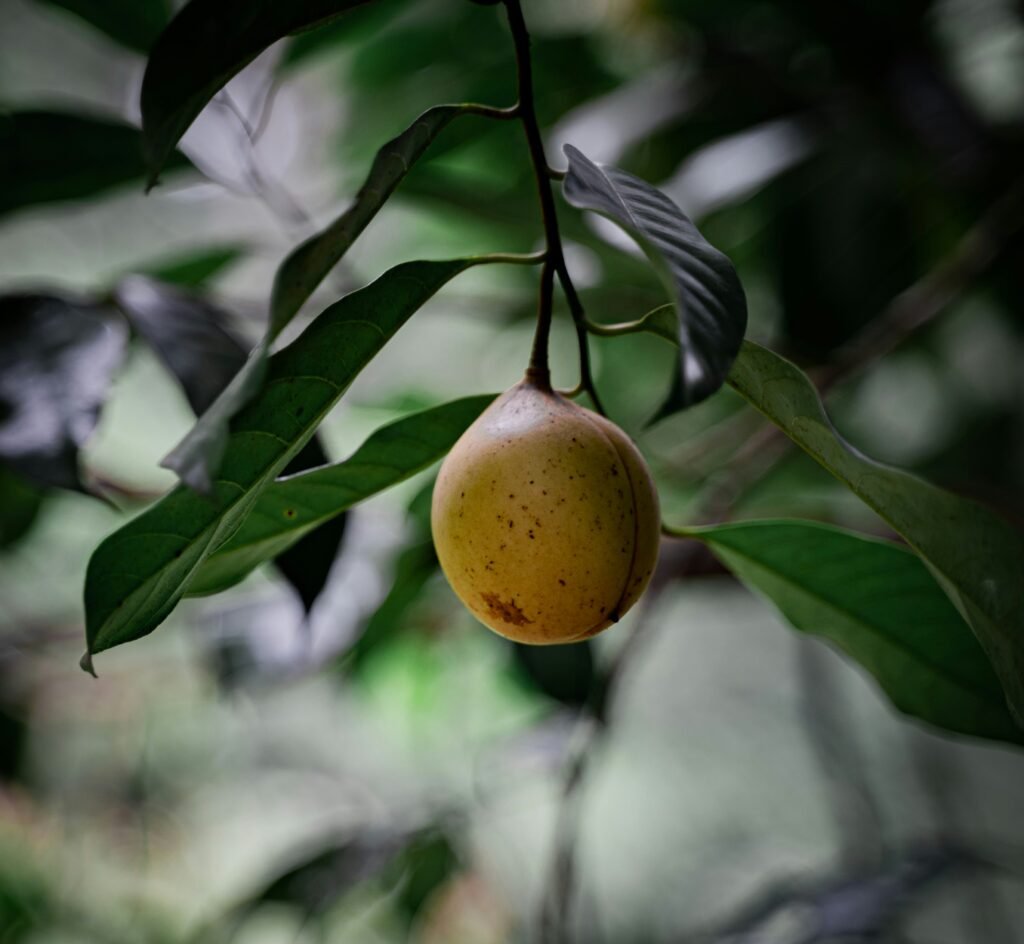
Further south, on the Banda archipelago, is the birthplace of the nutmeg (myristica fragrans). If the clove harvest is precarious, the nutmeg harvest is botanical theatre.
The drama lies in the reveal. The tree produces a pale, yellow fruit that looks like an unripe apricot. When it reaches perfect maturity, the fruit doesn’t just ripen, it ruptures. It spontaneously splits open on the branch to expose a striking, blood-red, lacy web (mace) gripping a glossy, dark seed (the nutmeg). You have to harvest it immediately; wait too long, and the fruit falls, bruising the delicate mace. To protect this fragile cargo, farmers don’t climb the trees. Instead, they reach up from the forest floor with long, specialized bamboo poles fitted with woven catching baskets, plucking the split fruit gently from the canopy.
Once on the ground, the meticulous processing begins. The thick outer flesh is sliced away. Then comes the delicate work of separating the two distinct spices. The crimson mace is peeled off the seed by hand. Keeping the lacy web intact requires the touch of a surgeon, as unbroken mace fetches a premium.
Both spices are then laid out in the sun. The mace dries quickly, fading from that vibrant blood-red into a brittle, pale orange. The nutmeg seed, still encased in its protective woody shell, takes weeks to cure. And just like the clove’s snap test, the nutmeg has its own sensory indicator. You don’t know it’s ready by looking at it. You know by listening. A perfectly dried nutmeg will rattle loosely inside its shell when shaken.
But the real brilliance of Banda isn’t just the seed. It’s the system. Nutmeg is notoriously fussy. It’s an understory tree. Expose it to the direct sun and it will scorch and die. The colonial powers struggled to transplant and commodify it for exactly this reason.
The indigenous solution? A highly engineered, multi-tiered agroforest.
Long before the Dutch or British arrived, Malukans cultivated towering kenari (Java almond) trees. These giants serve as the “mother trees.” Their deep roots stabilize the fragile volcanic earth, they drop highly nutritious nuts, and their massive, sprawling branches cast the exact amount of dappled shade the delicate nutmeg needs to thrive below.
To understand just how valuable this indigenous agroforestry was, we need to rewind nearly 400 years.
In 1667, the British and the Dutch signed the Treaty of Breda to end the Second Anglo-Dutch War. As part of the agreement, the British agreed to hand over a tiny, nutmeg-rich Malukan speck called Run Island to the Dutch, solidifying a Dutch monopoly on the spice. In exchange, the British received a swampy North American settlement called New Amsterdam.
We know it today as Manhattan.
We don’t share this anecdote to glorify colonial horse-trading, but to put the brilliance of Malukan agriculture into perspective. A single indigenous tree, sheltered under a kenari canopy on a two-mile strip of rock, was deemed more valuable than the future financial capital of the Western world.
The Original Masterclass in Conservation
When you live on a tiny volcanic speck surrounded by deep ocean trenches, you understand finite resources instinctively. There is no endless frontier to exploit. If you exhaust the soil or overfish the reef, you don’t just lose a quarter of your profits, you starve.
When European monopolies arrived, they operated with the frantic greed of men who knew they could always sail away when the dirt turned to dust. They stripped forests, imposed impossible quotas, and treated the islands like a infinite vending machine.
The indigenous communities of Maluku, however, operated under a different logic entirely.
Long before Western NGOs started flying into the tropics to host seminars on regenerative agriculture, the people of Maluku were executing a masterclass in ecology. They called it sasi.
Sasi is a centuries-old customary law. Simply put, it is a strict, deeply respected prohibition on harvesting a specific resource, on land or in the sea, for a set period of time. Think of it as an ecological cease-fire. When a resource shows signs of strain, or simply needs time to naturally multiply, the village leaders declare sasi. The harvest stops immediately. The prohibition gives the trees time to recover, the soil time to rest, and the marine life time to spawn without human interference. Anyone caught breaking sasi faces severe social and spiritual penalties.
Only when the ecosystem has fully regenerated is the sasi lifted, usually marked by a communal ceremony. This guarantees that the next harvest is both wildly abundant and ecologically sound.
It is a system built on profound botanical and biological science, disguised as tradition. The European empires looked at the Maluku Islands and saw a spreadsheet of commodities to extract. The Malukans looked at their islands and saw a delicate, living system that required constant maintenance, respect, and restraint.
Inside a Malukan Kitchen
If your exposure to nutmeg and cloves begins and ends with a dusting on a latte or a holiday pie, you are missing out. The West has long treated these spices as dry powders reserved for seasonal sweets. But in Maluku, they are the savoury foundation of daily survival.
To step into a Malukan kitchen is to understand that flavour requires kinetic energy. You won’t find jars of pre-ground powders. Instead, you find the cobek—a wide, flat mortar carved from the exact same volcanic basalt that the clove trees grow in.
Here, whole cloves and shards of nutmeg are pulverized by hand alongside fresh shallots, chilies, and lemongrass to create a bumbu (spice paste). This paste is then thrown into hot oil. The heat triggers a exuberance of essential oils, transforming the raw aromatics into a deep, complex base for the island’s daily stews and broths.
This indigenous botanical science extends far beyond the cooking pot. Europeans were only interested in the parts of the plant they could pack into the hull of a ship, but Malukans use the entire anatomy. Long before modern dentistry, the islanders were extracting minyak cengkeh (clove oil) to use as a potent, topical analgesic for toothaches and muscle pain. And that pale nutmeg fruit that ruptures so dramatically? While colonial traders threw the flesh away to get to the seed, Malukans brine it, candy it into a sweet-tart snack called manisan pala, or press it into vibrant, refreshing syrups.
While the high volcanic slopes provide the flavour, the lowlands of larger islands like Seram and Halmahera provide the medium.
The sago palm, a robust crop that grows wild in the swampy lowlands, quietly packs its massive trunk with a lusciously dense carbohydrate. Extracting sago is an ancient, labour-intensive process. The palm is felled, the spongy inner pith is pounded by hand, and the fibres are washed in the river to release the raw, white starch.
The real magic happens when it’s time to eat.
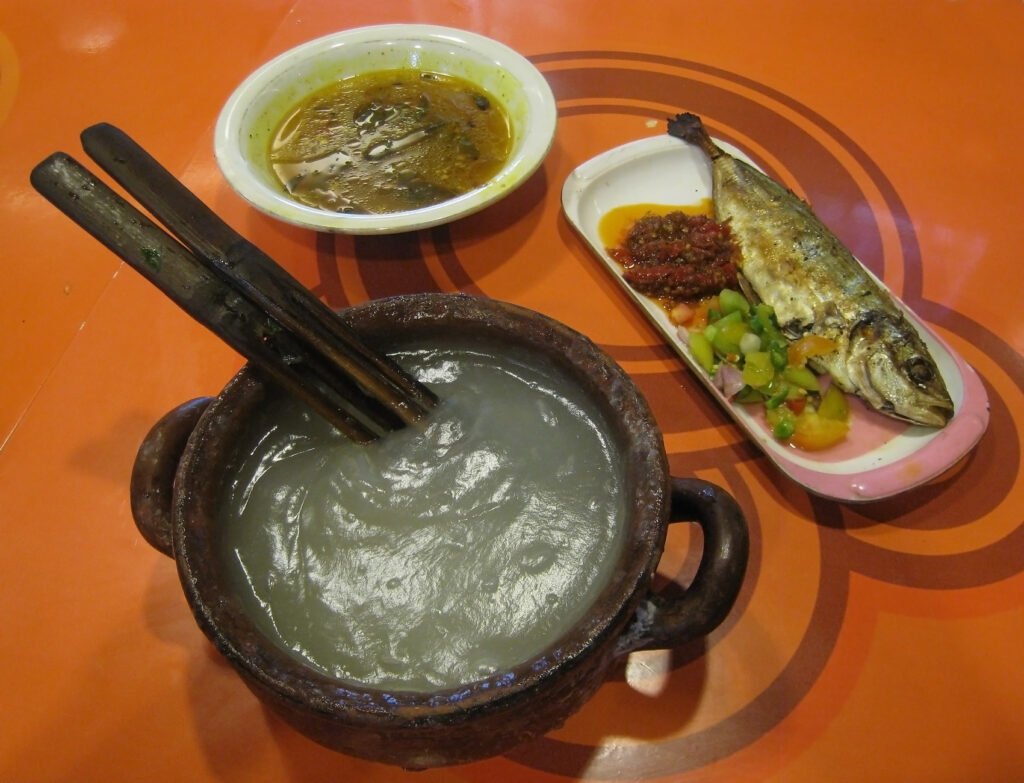
The iconic dish of the Malukus is papeda, a comforting sago porridge with a preparation process akin alchemy. The cook pours violently boiling water directly over a bowl of raw sago starch while stirring frantically. In seconds, the milky liquid seizes, transforming into a thick, translucent canvas.
Because of its unique texture, you don’t eat papeda with a spoon. You twirl it around a pair of wooden prongs, drop it into your bowl, and drown it in kuah kuning. This bright, acidic broth is heavy with turmeric, lime, and whole cloves. While conventionally served with fish, the absolute soul of the dish is the broth itself. The sago acts as a neutral, textural sponge, soaking up the fierce, hyper-local flavors of the islands. It’s a dish perfectly adapted to the wet lowlands.
The Map in Your Pantry
The Maluku Islands are not a museum trapped in a European history book. They are a vibrant, active landscape. Today, farmers in Ternate still balance on swaying bamboo ladders to harvest cloves by hand. The towering kenari trees of Banda still cast their protective shade over the delicate nutmeg. And in coastal villages across the archipelago, the regenerative laws of sasi are still declared to protect the future of the reefs and the soil.
So, the next time you are in your kitchen, open your pantry and find that little glass jar of cloves or whole nutmeg. Stop seeing it as a cheap supermarket commodity or a dusty afterthought. Look closer. You are holding the ash of a smoking caldera, the shade of a mother tree, and the undeniable brilliance of a culture that quite literally flavored the modern world.