


Thud. Thwack. Swish. Fold.
Walk past any courtyard in Ghana and Nigeria just before sunset, and you won’t just smell dinner—you’ll hear it. A rhythmic, heavy percussion echoing over cinderblock walls. It’s the sound of a dense wooden pestle meeting an equally solid mortar over and over. A steady, driving neighborhood metronome.
Thud. Thwack. Swish. Fold.
Fufu is the heartbeat of West African kitchens. The architectural foundation of the meal; the starchy canvas upon which the region’s most complex and vibrant soups are painted. But more than that, fufu is a living cultural technology preserved through muscle memory, communal labour, and a deep, indigenous understanding of how to transform stubborn roots and starches into silk.
If you read Western food media, you’ve probably seen fufu lazily described as “African mashed potatoes.” We need to set the record straight right now. Mashed potatoes are dead weight. They are static, fluffy, and engineered to surrender to the slightest pressure of a fork. Fufu, on the contrary, is alive. It has tension, bounce, and a defiant elasticity.
What we are talking about here isn’t a simple side dish meant to bulk up a plate. Fufu requires an intuitive grasp of plant biology, a staggering amount of physical endurance, and a rhythm passed down through generations. It is a story of absolute trust between the cooks in the kitchen, and the brilliant indigenous science of taking tough, unforgiving crops and pushing them to their absolute limits.
A Geography of the Stretch
To talk about fufu as if it’s a single, monolithic dish is a surefire way to expose yourself as an amateur. Fufu is a spectrum. The foundation changes depending on which borders you cross, and the ingredients you use will dictate the exact texture, flavor, and weight of the final swallow.
In Nigeria, the king of the swallow is the white yam. And let’s be clear—we aren’t talking about the sweet, orange tubers Americans mistakenly call yams during Thanksgiving. We mean dioscorea rotundata, a massive, starchy, indigenous powerhouse. When boiled and pounded, it transforms into iyan (pounded yam), arguably the most prestigious and heavy-hitting of the fufu family.
Cross into Ghana, and you’ll find an alliance of cassava and unripe plantains. The plantain brings a subtle sweetness and structural integrity, while the cassava provides the essential, bouncy stretch. Further down the coast, in places like Cameroon and Sierra Leone, you’ll taste the sour notes of “water fufu.” Cassava is left to ferment for days until it develops a funky, complex profile that rivals any high-end sourdough starter.
The Cassava Triumph
Speaking of cassava, we need to address a historical blind spot. Western history books love to suggest that Portuguese ships delivered cassava from South America to Africa like some sort of benevolent care package.
But here’s the thing: handing someone a bitter cassava root isn’t a gift, it’s a hazard. In its raw form, bitter cassava is packed with lethal cyanogenic glycosides. If you don’t know what you are doing, eating it will kill you.
The more important story isn’t about colonial introduction. It’s about indigenous food science. When cassava arrived, West African cooks, farmers, and matriarchs took one look at this tough, toxic root and set to work. They applied complex, pre-existing knowledge of fermentation, soaking, pressing, and roasting to neutralize the toxins. They ultimately tamed it, transforming a dangerous crop into a safe, shelf-stable, continental staple.
The Science of the Stretch
So, what exactly happens when those tamed roots meet the mortar?
When you boil a yam or a piece of cassava, the starch granules swell and soften. If you stop there and attack it with a potato masher, you just get a mealy pile of carbs. But when you introduce the heavy, driving impact of a wooden pestle, physics takes over.
The pounding doesn’t just crush the plant cells, it breaks them open, releasing long chains of starch molecules—amylose and amylopectin for those keeping score at home. As the pestle strikes and the hot dough is continuously folded, these microscopic chains untangle and align, binding together in a dense, flexible matrix. That’s where the “stretch” comes from and what gives fufu its iconic, bouncy resistance.
The Two-Person Dance
At the centre of the pounding process is the original heavy-duty food processor: the mortar and pestle.
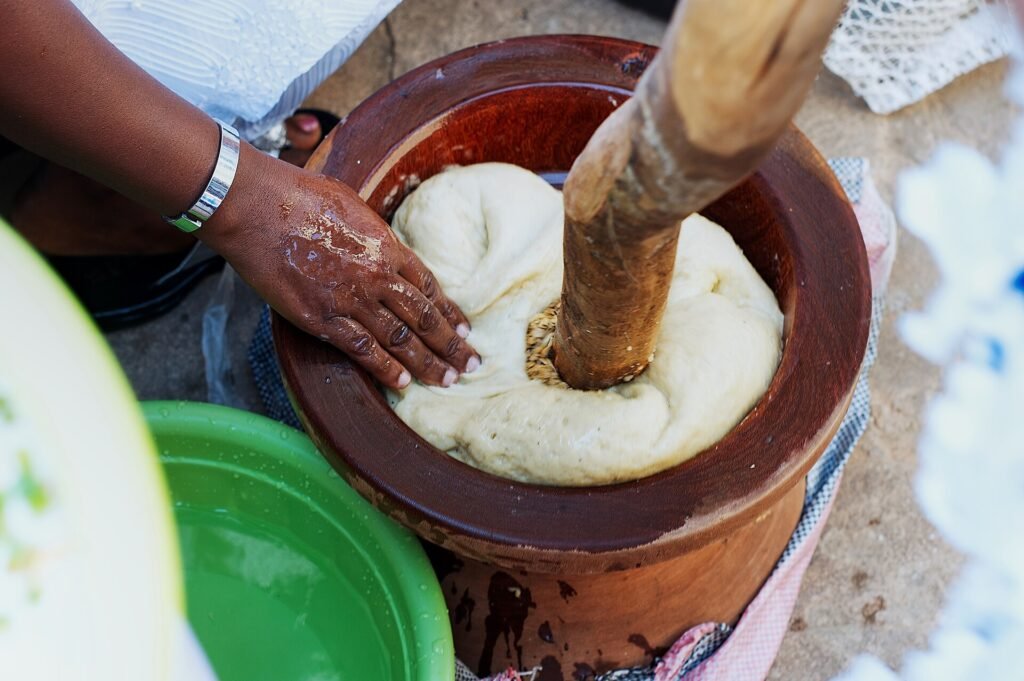
Wipe away any image of the delicate little marble bowl sitting on a Western countertop, the one used for lightly bruising a few basil leaves. A West African mortar (odo in Yoruba, wuduro in Twi) is a massive, waist-high vessel carved from dense, resilient hardwood. It is a family heirloom, seasoned by years of starch and sweat, built to withstand a daily beating.
The act of making fufu is a two-person dance. One person stands tall, driving the heavy wooden pestle downward with their full body weight. The other sits low, reaching into the mortar in the seconds between strikes to turn, fold, and occasionally wet the scalding hot dough.
Think about that for a second. You are sticking your bare hands under a heavy, blunt wooden club swinging down at high velocity. Lose the rhythm, and you lose a finger. A serious exercise in trust.
This relentless cardio session doesn’t end in five minutes. Depending on the size of the meal, it can take anywhere from thirty minutes to an hour of continuous, sweat-drenched pounding, turning, folding, and wetting.
And then there are the judges. Every West African family has a matriarch—an auntie or grandmother—who can critique the fufu without ever setting foot in the kitchen. She doesn’t need to look at it to know if it will be lumpy. She just listens. She knows exactly when the cadence of the pound shifts from the dull, heavy thud of raw starch to the wet, slapping swish of an aligned, perfectly stretched dough. You can’t hide bad technique from an ear trained by decades on the mortar and pestle.
When the matriarch finally nods her approval, the chaotic mass of boiled roots has been transformed. If you need a visual reference, imagine the smooth elasticity of warm mochi or the glossy surface of a massive ball of fresh mozzarella. But even those comparisons fall slightly short. The final product is a structural marvel—a dense carbohydrate cloud that holds a perfect spherical shape on the platter, yet yields completely to the warmth of your hands.
The Etiquette of the Swallow
Now comes the moment of truth, and with it, the most important rule of West African dining.
You do not chew fufu.
Every culinary instinct will scream at you to chew. Resist it. Chewing fufu is a rookie mistake that immediately ruins the textural magic the kitchen just spent an hour pounding into existence. Fufu is not the destination, it’s a ferry designed to carry complex soups and stews directly to your stomach. You swallow it whole, allowing the smooth dough to slide down effortlessly while the rich flavours of the soup linger on your palate.
To execute the perfect swallow, you have to abandon the cutlery. Fufu demands a tactile connection, specifically with your right hand. Feeling the temperature and texture of the food before it hits your mouth is a crucial part of the sensory experience.
You pinch off a bite-sized morsel—a swallow—and roll it gently against your palm until it forms a smooth ball. Then, using your thumb, you make a small indentation into the centre. You have just crafted an edible spoon. You dip this starchy vessel into the soup, making sure to capture the rich oils, the greens, and the heavy reduction. Then, in one seamless motion, it goes into your mouth and down the hatch.
This ritual almost never happens in isolation. Fufu is fundamentally communal. Diners gather around a central bowl, digging in with their right hands in a quiet choreography. There is a deep respect built into this shared dining. A social equalizer where everyone, regardless of status, shares the same temperature, the same spice, and the same rhythm of the meal. To eat fufu with someone is to share a space of culinary vulnerability and trust.
The Soups That Demand a Swallow
If fufu is the architectural marvel of the West African table, the soup is the soul. We are not talking about watery broths or light, translucent consommés. These are dense, nutrient-rich reductions that require hours of flavour-building and patience. The genius of these pairings is in the indigenous plant-based proteins and flavour profiles that define the region’s kitchens.
Egusi
If there is a king of the Nigerian soup canon, it’s egusi. Made from the protein-packed seeds of a local melon (citrullus lanatus), this dish is a masterclass in indigenous protein extraction.
The seeds are sun-dried, shelled, and ground into a fine powder. When folded into a simmering base of palm oil, locust beans (iru), and scotch bonnet peppers, the melon seed powder transforms. It coagulates, creating a rich, curd-like texture that is unapologetically heavy and luxurious. This isn’t a soup you slurp. It’s a stew that grips the smooth surface of fufu like a velvet blanket.
Groundnut Soup
Move west to Ghana, and you will encounter nkatie nkwan, better known globally as groundnut soup. This is not warm peanut butter, however.
While Western food culture largely relegated the peanut to childhood sandwiches and sugary snacks, West African cooks recognized it as a foundational savory ingredient. To make nkatie nkwan, roasted peanuts are ground into a paste and slowly cooked down with tomatoes, onions, garlic, and unforgiving amounts of ginger and chili. The oil separates, rising to the top in a fiery crimson layer, while the base thickens into a earthy magma. The result is complex and perfectly cuts through the subtle sweetness of plantain-based fufu.
Ndolé
For true culinary alchemy, look no further than Cameroon’s beloved ndolé. The star ingredient here is bitterleaf (vernonia amygdalina). As the name suggests, the leaf in its raw form is almost aggressively bitter.
But indigenous cooks have never shied away from difficult ingredients. The preparation of ndolé involves a laborious process of repeatedly washing, boiling, and squeezing the bitter leaves to strip away just enough astringency. What remains is a complex umami flavour. Once blended with a creamy peanut base and aromatics, the stew hits every note on the palate—savory, nutty, and faintly, pleasantly bitter. Ndolé is proof that the greatest tropical dishes aren’t simply foraged, they are meticulously crafted.
The Fufu Futurists
When millions of West Africans migrated beyond West Africa, they didn’t leave their appetites behind. But they did face a logistical nightmare. The traditional mortar and pestle were designed for open-air, sun-baked courtyards, not third-floor walk-up apartments in London, Toronto, or New York.
The stories of diaspora cooks trying to pound yam on a Tuesday night are the stuff of legend. You either wait for the downstairs neighbour to leave for their shift, or you fold thick winter blankets under the mortar to muffle the concussive blows. It is a hilarious, beautiful, and stubborn dedication to the swallow. Try explaining to your landlord that the rhythmic thud shaking their ceiling is actually your dinner.
Then came the great compromise: boxed fufu powder.
Walk into any African market in the West today, and you’ll see walls of boxes promising instant fufu, pounded yam, or plantain dough. Just add hot water and stir furiously over an electric stove with a wooden spoon. Purists will inevitably tell you that the powder lacks the soul, the moisture, and the true, bouncy resistance of the original. Pragmatists, however, will point out that it allows you to enjoy a taste of home after a 12-hour nursing shift without losing your security deposit. It’s a debate that rages in WhatsApp groups across the world.
Beyond the powder, there is the Holy Grail of diaspora engineering: the automated fufu pounder. For decades, inventors and engineers have tried to build machines that can replicate the exact human motion of the “pound-and-fold.” No one has ever really been able to recreate the magic of the mortar and pestle. Why? Because it isn’t easy to digitize intuition, the feeling of the dough, and the matriarch’s ear.
The Rhythm Goes On
Which brings us back to the courtyard.
In an era of instant gratification and hyper-processed convenience foods, true fufu remains stubbornly physical. It demands your time, your sweat, and your undivided attention. It refuses to be simplified, and it certainly refuses to be called mashed potatoes.
Fufu is a testament to the fact that the most incredible things we eat aren’t just grown in the soil. They are forged by human hands and perfected over millennia of trial, error, and rhythm.
So, if you ever find yourself sitting around a communal bowl, take a moment to respect what you are about to eat. Fufu isn’t just a meal, it’s part of the foundation of West African history.g