

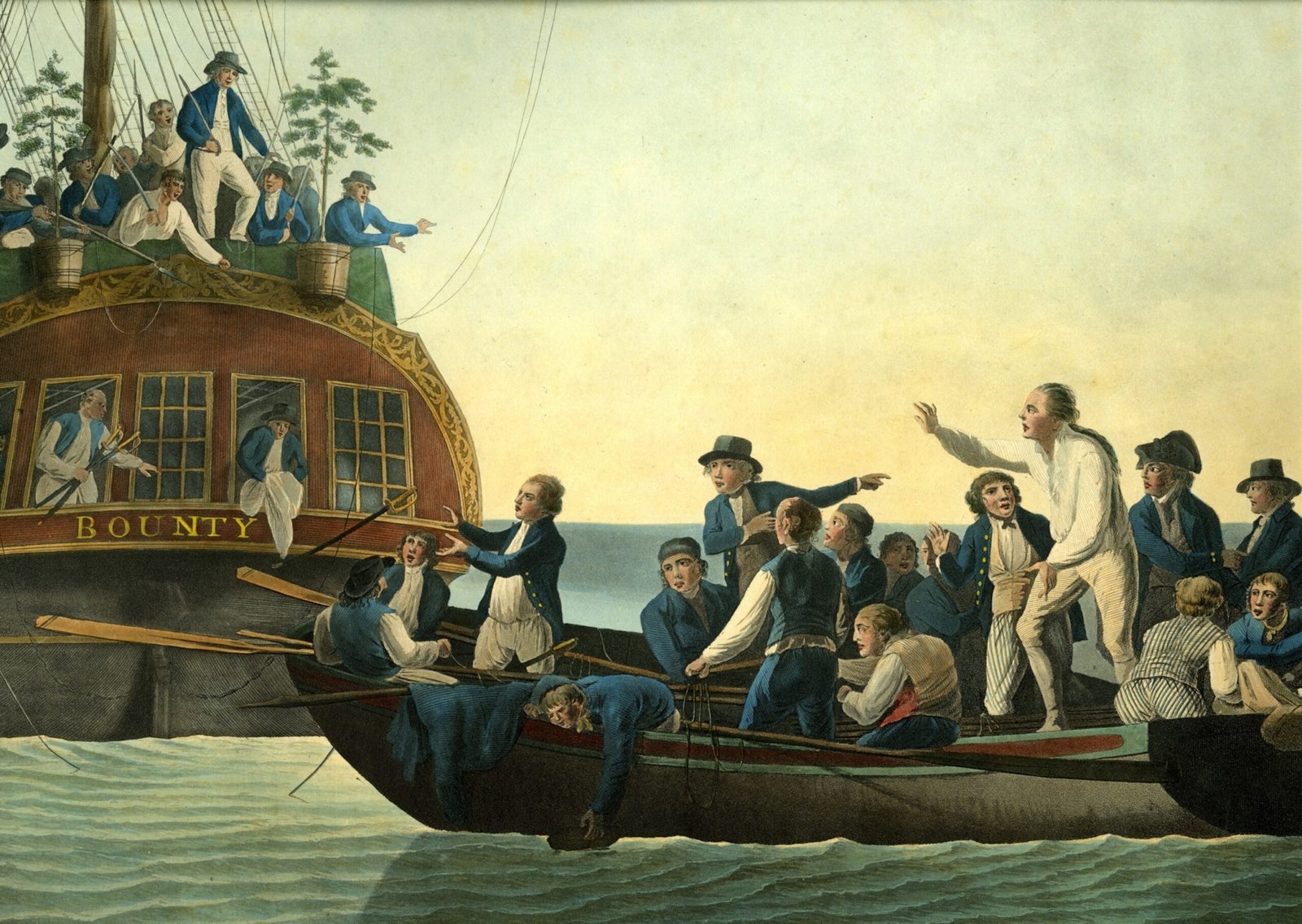
You may have heard of the Mutiny on the Bounty. That 18th-century tale of a tyrannical Captain Bligh, a rebellious Fletcher Christian, and a desperate crew who decided they’d rather take their chances in a rowboat than spend another day under the thumb of a madman.
If Hollywood’s 1962 rendition is to be believed, the incident is a romanticized epic about egos, lashes, and the irresistible lure of a Tahitian paradise. All the necessary ingredients of a high-seas soap opera.
But as is so often the case, Hollywood (and history books) hasn’t told the whole story.
You see, the HMS Bounty wasn’t just a ship, and the real star of the voyage wasn’t a man in a tricorne hat. The mutiny is really a story about a plant. Specifically, a bumpy, green, starchy globe that the British Empire was so desperate to possess that they literally remodeled a warship to accommodate it. Imagine that for a second: the crew crammed into the humid bowels of the vessel, while the Great Cabin housed 1,000 potted breadfruit saplings. No wonder things got ugly for Mr. Bligh.
We aren’t here for the maritime melodrama, however. What we’re really interested in is the theft of a superfood. Because before it devolved into a mutiny, the Breadfruit Voyage, as it was christened, was a calculated attempt by a colonial power to turn a tropical plant into cheap fuel for an empire built on sugar and suffering.
It’s time we stop talking about the mutiny and start telling the real story of the Breadfruit Heist.
3,000 Years of R&D
When Captain Cook and the botanist Joseph Banks first laid eyes on breadfruit in Tahiti in 1769, they wrote about it like they’d stumbled upon a miracle in the wild. Banks was particularly smitten, noting that in the time it took a man to plant ten trees, he could fulfill his “duty to his own as well as future generations.”
Cook went even further, marveling that if a man planted but ten breadfruit trees in his life, he would do as much for his family as “a native of our temperate clime… [who] plows in the cold of winter and reaps in the summer’s heat.”
Heady stuff, for the European mind.
At the time, surely driven by the embellishment of returning voyagers, Europeans truly believed the tropics were a place of spontaneous abundance where you could literally lie under a tree and wait for lunch to fall into your lap.
But here’s the thing: breadfruit wasn’t a lucky find. It was a highly engineered piece of agricultural technology. The result of 3,000 years of research & development by Austronesian navigators.
That’s right. Centuries before the British even knew how to sail out of sight of land, Pacific Islanders were traversing the world’s largest ocean in double-hulled canoes. But they weren’t just exploring. They were themselves colonizing, with intention. And their most important piece of cargo? The breadfruit (Artocarpus altilis).
These indigenous scientists didn’t just harvest a wild fruit; they master-bred it into an agricultural powerhouse. They transformed a seeded, less-reliable wild ancestor into hundreds of seedless, high-yield varieties, each adapted to different soils, salt levels, and micro-climates. They turned a seasonal plant into a year-round “Staff of Life.”
And the breadfruit wasn’t just a food. It was a spiritual pact, a cultural anchor, and a stalwart of food security. In Hawaii, for example, the god Kū is said to have turned himself into a breadfruit tree to save his family from famine.
So when the British showed up, they certainly didn’t discover the breadfruit. They walked into a high-tech indigenous laboratory and decided they wanted the intellectual property for themselves. But as was so often the case, they missed the point. Sure, you can steal the sapling, but you can’t steal the three millennia of soul and science that made it grow.
The Imperial Spreadsheet
By the late 1700s, the British Empire had a problem. The newly independent Americans were no longer interested in sending cheap salt fish and corn to feed the enslaved populations on British sugar plantations in the Caribbean. The resulting increase in the cost of sugar production set off alarm bells in London.
To understand the urgency, we need to look at the era’s sugar fever. In the 18th century, sugar wasn’t just a sweetener, it was white gold. The oil of its day, it drove the global economy and fuelled the industrial rise of Europe. But this addiction came at a staggering human cost, sustained entirely by the brutal system of chattel slavery.
When the supply chain for salt fish and corn collapsed, the British didn’t look for more humane ways to treat their slaves. What they wanted was an cheap, alternative fuel to keep their “Engine of Empire” running at full speed.
Enter our botanist, Mr. Banks, and his imperial spreadsheet.
Banks didn’t see the breadfruit as a cultural and botanical treasure. He saw it as a cheap, calorie-dense, low-maintenance solution to the Empire’s problem. In other words, a way to squeeze more profit out of every acre of Caribbean soil.
It’s here that the heist turns dark. What the British effectively wanted to do was weaponize indigenous R&D to subsidize their slave-powered sugar industry.
The plan was simple: steal the technology of the Pacific to lower the cost of feeding the Atlantic slave trade. It was a cold, calculated move to turn a sacred plant into a key cog in the colonial machine. And it was this exact calculation—this refusal to see the plant (or the people) as anything more than numbers on a balance sheet—that set the stage for the most famous mutiny in history.
The Mutiny
If you want to know why the mutiny happened, avoid the temptation to look at the personalities of the men involved. Consider instead the logistics of the ship itself.
When the Bounty departed Tahiti in 1789, it resembled a floating greenhouse. The breadfruit saplings were given the royal treatment while the men were treated like cattle. Come to think of it, cattle would probably have been treated better.
Nowhere was this contrast more stark than with the allocation of fresh water.
In the middle of the Pacific, there isn’t a more important resource. As they sailed through the scorching heat, Captain Bligh issued a decree that prioritized the survival of the heist over the survival of the men. To ensure the “saviour” of the British Empire didn’t wilt, the breadfruit saplings were to be watered first.
Imagine the scene: sailors parched with thirst, watching as life-saving water was poured into dirt for a plant destined to be the industrial fuel for a workforce in chains. No wonder things got out of hand.
For all of Mr. Bligh’s shortcomings, the mutiny wasn’t so much a reaction to him as it was a reaction to an Empire that had quite literally placed the value of a commodified plant above the value of human life. So when Fletcher Christian and his men threw the breadfruit pots overboard, they weren’t just reclaiming their water supply. They were tossing the colonial spreadsheet into the ocean.
But as history shows, the Empire wasn’t done yet. Bligh would return, and the breadfruit would eventually make its journey. But, as the famous saying goes, you can lead a horse to water, but you can’t make it drink.
Rejection and Rebirth
Captain Bligh eventually got his second chance. In 1793, aboard the HMS Providence, he finally managed to deliver the botanical heist to St. Vincent and Jamaica. But don’t mistake this for a voyage of redemption or humanity. Sure, the ship was larger and the water and food were distributed more evenly, but there were also more armed marines to keep the “cattle” in line. It was clear the Empire had learned its lesson: to steal a superfood, you need a lot more stick than carrot.
You wouldn’t be faulted for thinking the story ends there. It probably would’ve been the case except for one small issue: the enslaved people refused to eat the breadfruit.
For decades, the breadfruit toiled in the Caribbean as a pariah. The enslaved populations looked at it and saw exactly what it was: the food of the oppressor. It was a plant forced upon them to make their lives cheaper to maintain. To eat the breadfruit, it can be said, was to swallow the logic of the plantation.
It took generations of resistance and creativity for the communities of the Caribbean to reclaim the plant. They didn’t just eventually accept it, they colonized it back. They seasoned it with the spices of the tropics, roasted it over open fires, and integrated it into iconic dishes like Grenada’s oil down. In doing so, they brought the breadfruit full circle: from “Staff of Life” to commodity and back again.
Colonial records tend to gloss over this part. They frame Bligh’s misadventures as a maritime success built on a foundation of British genius. In reality, breadfruit became a Caribbean icon because of local resilience, not imperial planning.
As you can see, the Mutiny on the Bounty isn’t the full story. If anything, it’s a footnote in a much larger story of the British Empire’s attempt to simplify the tropical world into a single, efficient input for industrial production. They tried, and failed, to use breadfruit to fuel a system of suffering, discovering in the process that you can’t strip the soul out of a plant that was bred with love and purpose.
Next time you sit down to a meal of breadfruit, or any tropical wonder, remember that you aren’t just eating a meat alternative. You’re eating a piece of history that refused to be conquered.