

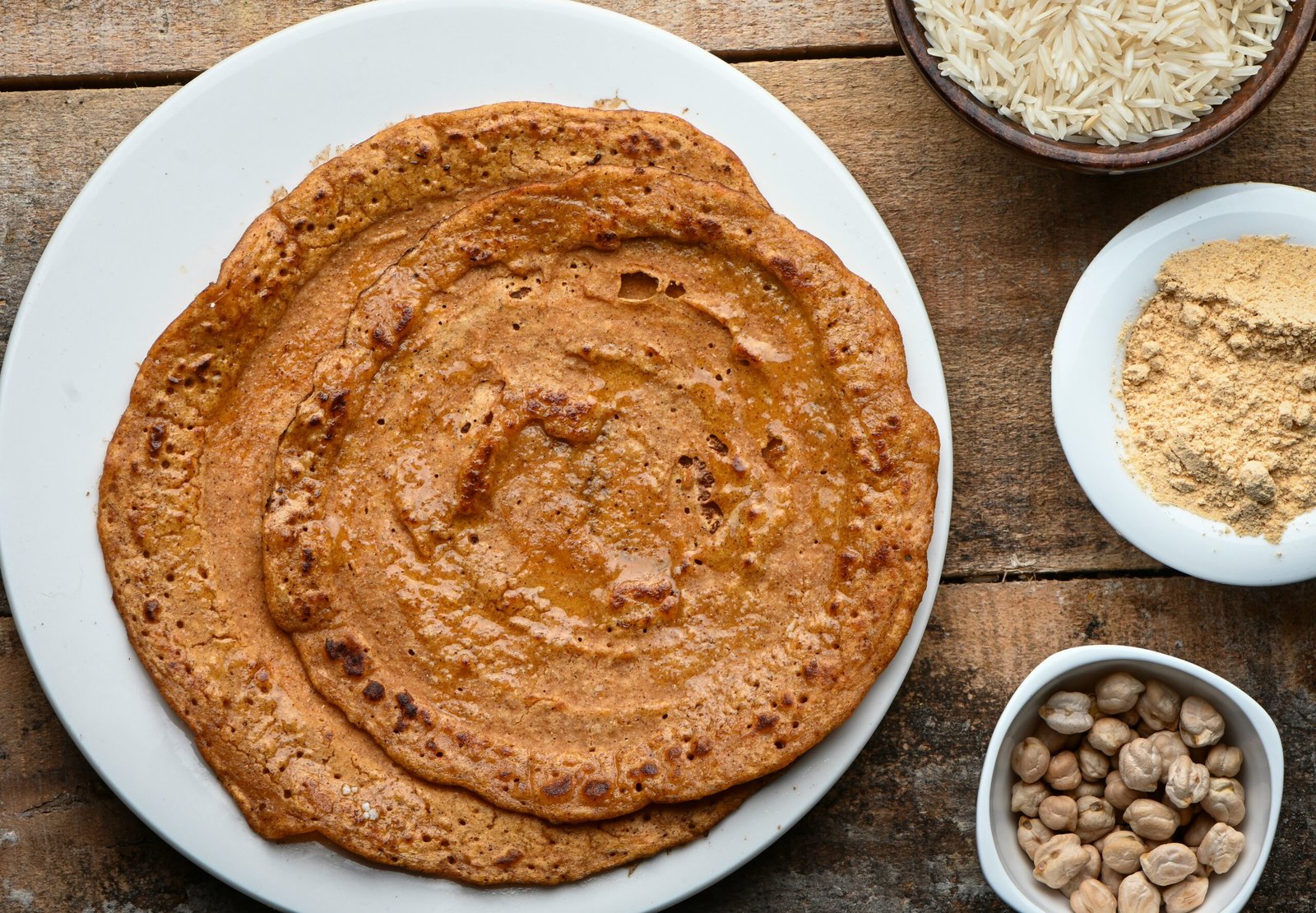
The dosa is the antithesis of fast food. Walk into a tiffin kade any morning and you’ll find the house specialty: a dosa cooked a full metre long on the tawa, then rolled into a tapering cone, held together by nothing but batter. No flour, no eggs — just rice, lentils, and time.
Everything about it is slow and deliberate. It starts with a handful of black dal, husked, soaked, and ground under a heavy stone into a thick, foamy paste. A handful of rice is soaked and ground the same way. The two pastes are mixed, a dash of finely ground fenugreek goes in, and a new batch of batter has, quite literally, come to life — fermentation begins immediately.
Even with modern blenders and grinders standing in for the stone, the process resists shortcuts. The rice and dal need hours to soak. The batter needs hours more to mix and ferment, doubling in size before it’s ready to hit a smoking tawa and become the light, griddled cake that has anchored South Indian breakfasts for over 2,000 years.
The results are extraordinary: crisp, aerated, structured without a scrap of animal fat, packed with protein without meat, milk, or eggs, fermented without any added culture at all. That structure — the thing that lets a dosa stretch three metres and still hold its shape — comes entirely from the rapidly fermenting dal, not from oil and flour the way most batters get their body.
Hot off the pan, a dosa is a delicious, textured base for gravies, seafood, meat, even chocolate and cheese — it isn’t short on versatility. But it earns its reputation as a vegetarian staple: it hands protein to people who’ve sworn off meat and turns a bowl of vegetable stew or a plate of chutneys into a complete, meat-free meal.
It’s often filed under “South Asian crepe” — a tidy shorthand, and one that quietly assumes the crepe is the standard the dosa is being measured against. Line them up, though, and it’s worth asking who actually has who beat.
None of that is a knock on the crepe. Done well, it’s a genuinely great breakfast — thin, silky, and mild enough to disappear under whatever you put on it, from butter and sugar to ham and gruyère to a spoon of Nutella. That’s the trade a crepe makes on purpose: flour, eggs, and fat, kept deliberately simple and unfermented so it can play canvas to anything.
The dosa asks for more patience and pays it back differently. The hours of fermentation that a crepe skips are exactly what unlock vitamins and make the finished dosa easier to digest — chemistry a simpler batter was never built to do. Line up the numbers and the gap is hard to miss:
| Plain Dosa | Plain Crepe | Advantage | |
|---|---|---|---|
| Main starch source | Fermented rice + urad dal | Refined wheat flour | Dosa |
| Protein | Moderate (5–6 g) | Moderate (3–4 g) | Dosa |
| Fibre | 2–3 g | <1 g | Dosa |
| Saturated fat | Very low | Moderate (butter + milk + egg) | Dosa |
| Cholesterol | 0 mg | 30–70 mg | Dosa |
| Fermentation | Naturally fermented | Usually none | Dosa |
| Glycaemic response | Moderated by fermentation and lentils | Often higher with refined flour | Slight edge: Dosa |
| Micronutrient availability | Improved through fermentation | Conventional | Dosa |
| Vegan | Yes (traditional recipe) | No | Dosa |
| Gluten-free | Yes (traditional recipe) | No | Dosa |
| Digestibility | Enhanced by fermentation | Good but unfermented | Dosa |
| Flavour complexity | Tangy, savoury, fermented | Mild, soft, buttery | Dosa |
It shows up in the eating, too. A crepe is soft and quietly bland by design, built to take on flavour rather than bring its own. A dosa arrives with a tang already in it — a sourdough-adjacent umami — and a crisp, aerated crackle no folded crepe can manage.
Both are excellent at what they’re trying to be. But only one of them was quietly solving a nutrition and engineering problem for two thousand years while doing it — using nothing but a stone, some lentils, and patience.