

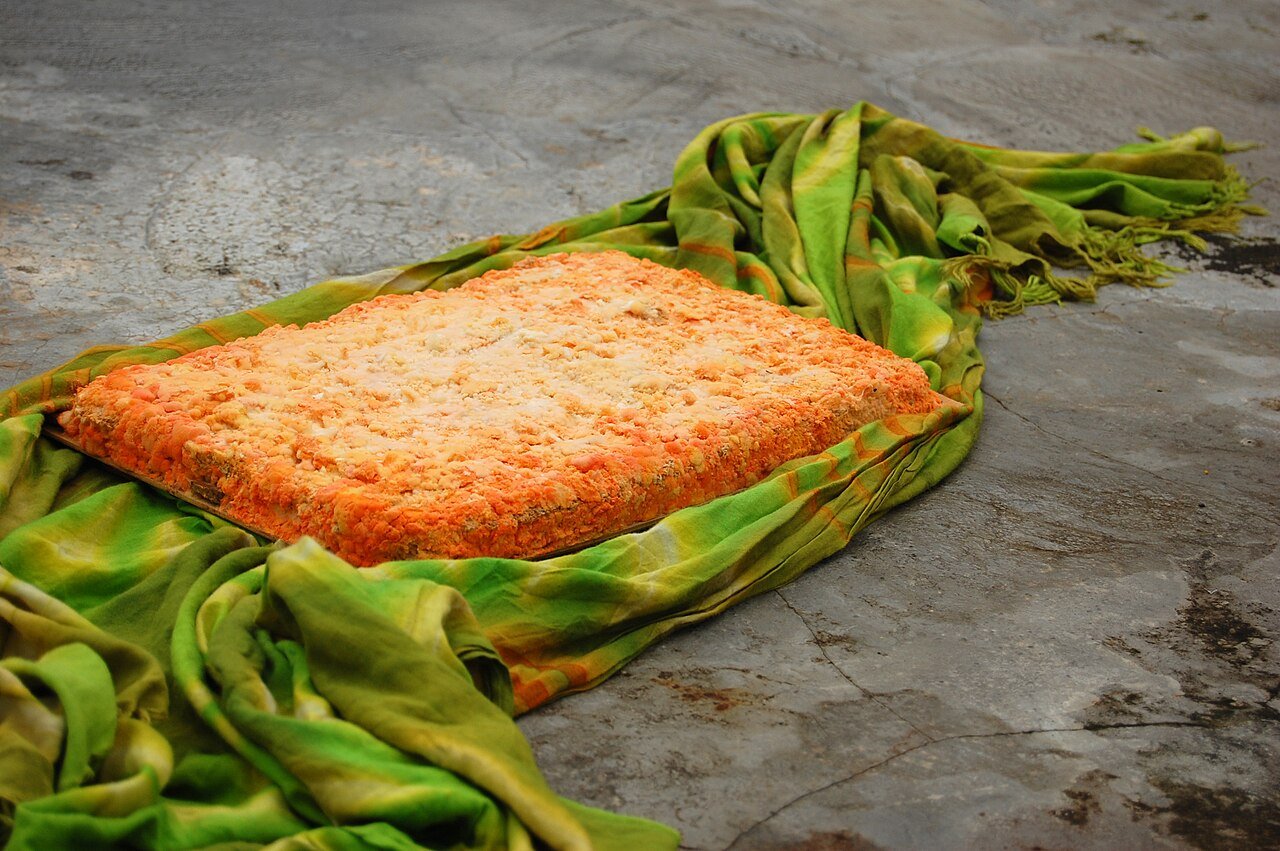
Walk through a traditional Sundanese market in West Java, past the overflowing baskets of snake fruit and the towering bundles of fresh lemongrass, and you will eventually see it. Sitting proudly on a wooden table, almost vibrating against the muted greens and browns, are blocks of neon-orange and jet-black fuzz.
If you don’t know what you’re looking at, the sight might trigger a cautious instinct. But to the people of West Java, those fuzzy rectangles aren’t a sign of spoilage. They are oncom (pronounced ohn-chohm). And they represent one of the most brilliant feats of indigenous food engineering on the planet.
Now, transport yourself out of that market and walk down the aisle of any high-end grocery store in London, Brooklyn, or Los Angeles. You’ll find shelves lined with snacks marketed in sleek, minimalist packaging, boasting buzzwords like “circular economy,” “zero-waste,” and “upcycled.” Brands backed by millions in venture capital will happily charge you $15 for a bag of crackers made from fruit pulp, patting themselves on the back for hacking the food system to eliminate waste.
But long before Silicon Valley tech-bros started trying to disrupt the concept of garbage, the Sundanese people had already perfected the ultimate circular economy. We aren’t introducing oncom as a quaint curiosity or a byproduct of desperation. We are introducing it as a profound piece of indigenous biochemistry.
An Industrial Blind Spot
To understand the genius of oncom, you first have to understand what it’s made of. The answer lies at the end of a very long, very traditional assembly line.
In Indonesia, the production of tofu and the extraction of peanut oil are massive operations. When you make tofu, you soak and grind soybeans, extracting the milky liquid and leaving behind a large volume of starchy pulp known as okara. When you press peanuts for oil, you’re left with a similar byproduct called peanut press cake.
To a European colonial agriculturalist or a modern industrial factory boss, this leftover pulp is dead weight. It’s viewed as waste because their processing methods are strictly linear: you extract the primary value and discard the rest. At best, this biomass is shoveled into a trough as cheap cattle feed. At worst, it’s destined for the compost heap.
But the indigenous cooks and farmers of West Java didn’t look at this pulp and see waste. They looked at it and saw locked potential.
They understood that while the primary fats and liquids had been extracted, the remaining fibres were still packed with complex carbohydrates and trapped proteins. They just needed to engineer the right biological key to open it.
Fungal Alchemy
The key they engineered was solid-state fungal fermentation.
Depending on the region and the base ingredient, oncom production utilizes specific molds. Red oncom, typically made from peanut press cake, relies on Neurospora intermedia, which gives the block its neon-orange bloom. Black oncom, made from the soy okara, relies on Rhizopus oligosporus—the same hardworking fungus responsible for tempeh.
But make no mistake: creating oncom is not just a matter of leaving garbage out in the humid tropical air to rot. It’s a meticulous, labor-intensive scientific process.
The leftover pulp must first be heavily washed to remove impurities. It’s then soaked and vigorously steamed. This isn’t just about cooking the fibres. It’s a sterilisation process designed to kill off any unwanted bacteria that might hijack the fermentation.
Once the sterile pulp cools, the inoculation begins. The artisans introduce the specific fungal spores, packing the mixture into flat bamboo trays or banana leaves. From here, it’s a waiting game that requires an intuitive understanding of tropical temperature control and airflow.
Over the next 48 hours, the magic happens. The fungus wakes up and goes to work. It sends microscopic tendrils (mycelium) weaving through the loose, granular pulp. As it grows, the fungus releases powerful enzymes that digest the complex, indigestible fibers, breaking them down into highly bioavailable amino acids and easily digestible proteins.
When the 48 hours are up, the loose powder has been completely transformed. The mycelium acts as a glue, binding the scraps into a dense block, crowned with that brilliant orange or jet-black fuzz.
Upcycling for Survival
During the 19th century, the Dutch colonial empire instituted the Cultuurstelsel, or Cultivation System, across the Indonesian archipelago. It was a brutally extractive policy. The colonizers commandeered West Java’s incredibly fertile volcanic soil, forcing local farmers to abandon their own food crops to grow cash crops for the European market—coffee, tea, sugar, and indigo.
The empire siphoned off the premium proteins and the high-yield rice, shipping the wealth back to the Netherlands and leaving the indigenous populations with the literal dregs of the agricultural economy. The Sundanese were deliberately pushed to the margins of their own land, facing engineered famine.
But instead of starving, they leaned on ancestral knowledge.
Western food history lazily labels foods like oncom, or even the more famous tempeh, as “peasant food” or “poverty meals,” implying a lack of sophistication. We challenge this narrative directly. Nothing could be further from the truth.
By applying advanced solid-state fermentation to the empire’s “trash,” the Sundanese engineered a hyper-nutritious, shelf-stable protein source. The Dutch thought they had taken everything of value, completely unaware that the local population possessed the expertise to turn factory floor scraps into the very fuel that allowed their communities to outlast the forces trying to starve them.
The Flavour Blueprint
You might assume that a food born from pressed pulp and mold would taste like a compromise. You would be wrong. The fermentation process doesn’t just alter the nutritional profile of the pulp, it creates an umami bomb.
Raw oncom smells earthy and distinctly alcoholic. But when it meets heat, it transforms. It develops a deep, nutty, and distinctly meaty flavor profile that commands attention in the kitchen. It isn’t used as a bland sponge to soak up other flavors; oncom is the flavor base.
If you want proof, you only need to look at West Java’s street food and traditional kitchens.
Combro
Take combro, a beloved Sundanese street snack. The name is an abbreviation of oncom di jero, which translates literally to “oncom inside.”
To make it, oncom is mashed into a paste with fiery bird’s eye chilies, garlic, and scallions. This mixture is then stuffed inside a ball of freshly grated cassava and deep-fried until golden. It’s a crispy, heavy-hitting snack that serves as a handheld testament to using absolutely every part of the harvest.
Tutug Oncom
For a true masterclass in savoury depth, there is nasi tutug oncom.
The preparation begins with fire. The block of oncom is roasted or grilled over open flames, a process that toasts the fungal spores and activates a smoky aroma. The charred block is then thrown into a cobek—the heavy, volcanic stone mortar that is the centerpiece of the Indonesian kitchen.
Here, it is pulverized alongside kencur (an aromatic, almost medicinal rhizome endemic to the region), fresh shallots, garlic, and chilies. The cook pounds the mixture into a fragrant rubble, which is then mixed into steaming hot rice. The fat and heat of the rice rehydrate the oncom, turning every single grain into an intensely earthy experience.
The Myth of Modern Sustainability
The West has a terrible habit of “discovering” concepts that the rest of the world has been practicing for centuries, packaging them in new vocabulary, and selling them back to us at a premium.
We need to stop treating indigenous methods like oncom production as quaint traditions and start respecting them as the advanced food science they actually are. The Sundanese didn’t just stumble upon a way to make garbage palatable. They mapped the biological lifecycle of specific fungi to solve a complex nutritional and environmental problem.
So, the next time a venture capital-backed startup tries to sell you an expensive upcycled snack to save the planet, remember the food scientists of West Java. They didn’t need a marketing budget or a buzzword to build a circular economy. They just used their hands, their soil, and their absolute refusal to let a single drop of potential go to waste.